Last updated: January 2026 to reflect current TRD guidance on foreign-sourced income.
Quick Answer / Key Takeaways
- Who typically needs a TIN: People who need to file a Thai personal income tax return, or who have Thai-sourced income, or who are asked for a TIN by a bank for compliance (e.g., CRS due diligence).
- When it often matters most: If you are a Thai tax resident (generally 180+ days in a tax year) and you remit assessable income into Thailand, you may have a filing obligation and therefore may need a TIN.
- Where to apply: Your district Revenue Office (the office responsible for your registered address).
- Common documents: Passport, visa/entry stamp, proof of address (must match TM30/address records), and any local forms required by the district office (e.g., L.P. 10.1).
- Processing time: Many offices issue quickly (sometimes same day), but timing varies by district and completeness of documents.
Definitions (quick)
- TIN: Thailand Tax Identification Number used by the Revenue Department to identify taxpayers.
- Assessable income: Income that is generally included in the Thai tax base under the Revenue Code (whether fully taxable depends on the facts and category).
- Tax resident: Generally, a person who is in Thailand for a total of 180 days or more in a tax year.
- Remitted / brought into Thailand: Moving money/income into Thailand (e.g., bank transfer, cash, or other mechanisms) — treatment can depend on evidence and timing.
- Tax year: Usually the calendar year (1 January to 31 December) for Thai personal income tax.
Thailand’s tax rules changed in 2024 and many foreigners now need a Tax Identification Number for the first time. If you spend a significant amount of time in Thailand, remit assessable income into the country or plan to file a tax return, a TIN is essential.
In other countries, this may be called a tax ID, taxpayer identification number or tax identification number, but in Thailand, it is usually referred to as a Tax Identification Number or TIN.
This guide explains everything clearly. You will learn who needs a TIN, how the rules work, the required documents, where to apply and how to avoid common problems that delay applications.
It is designed to give expats a practical and up-to-date overview of the rules so you know exactly what to do and when to take action.
If you prefer not to visit the Revenue Office, you can apply through our secure online service. Our licensed team manages the full process and keeps you updated at each stage.
What Is a Thailand Tax Identification Number (TIN)?
A Tax Identification Number is a unique number issued by the Thai Revenue Department. It identifies you within the tax system and links to your tax filings, bank information and reporting obligations.
Your Thailand TIN is your personal tax ID number used on all tax filings and official correspondence.
This guide focuses on personal Tax Identification Numbers for individuals. Company tax IDs follow a different registration process.
Important: The following tax information is general guidance only. Outcomes can depend on your specific facts, evidence (including tracing and bank records), and current Thai Revenue Department practice.
Why TINs Matter More Since 2024
From 1 January 2024, Thailand taxes foreign income brought into the country during the year it arises. If you are a tax resident and remit income such as a pension, investment gains or employment income, you must file a tax return. A TIN is required before you can file.
Income earned before 2024 is not taxed when remitted and this distinction is important for many expats.
How TINs Link to Global Reporting
Thailand participates in the OECD’s Common Reporting Standard. Banks and financial institutions exchange account information automatically with tax authorities worldwide. A TIN helps institutions match information to the correct taxpayer record and may be requested as part of standard compliance and due-diligence processes. Exact requirements can vary by institution and account type.
Why Banks and Institutions Request a TIN
Banks may request a TIN when you open accounts or invest in financial products because they must record your tax identification under global reporting rules and confirm your tax residency status.
Do You Need a Thailand TIN?
Whether you need a Tax Identification Number depends on three points: how long you stay in Thailand, whether you remit assessable foreign income and whether you earn income from Thai sources. Once you understand these tests, it becomes clear when a TIN is required.
You Need a TIN if Any of the Following Apply
- You spend 180 days or more in Thailand and remit assessable foreign income.
- You receive Thai-sourced income, such as employment income, freelance or contract work, property rental income or gains from selling Thai assets
- You are required to file a personal income tax return for either Thai income or assessable foreign income remitted if you are a Thai tax resident
- A bank or financial institution requests a TIN for CRS or compliance purposes as part of their standard due-diligence process
Use the decision tree below to help you determine if you need a Thailand TIN.


Real Examples
Retiree
A British retiree receives a pension abroad. If he brings the pension into Thailand, he needs a TIN and must file a tax return.
Long-Stay Visitor
A visitor who spends fewer than 180 days in Thailand and does not earn Thai income normally does not need a TIN.
New Expat Relocating
A new resident who moves to Thailand mid-year and remits overseas earnings during that same year needs a TIN once they pass 180 days. If no remittance takes place, they may not need a TIN until they file a return or remit income in a later year.
Digital Nomad
A remote worker earning income abroad who stays 180 days and remits funds into Thailand must apply for a TIN because the remittance triggers a filing requirement.
Business Owner
A foreigner running a business abroad who brings profits into Thailand during the year needs a TIN even without Thai-sourced income.
Property Seller
A foreigner who sells property in Thailand must obtain a TIN to report the transaction and file the relevant tax return.
Documents You Need to Apply for a TIN
Use the table below as your checklist for applying for a Thailand Tax ID number.
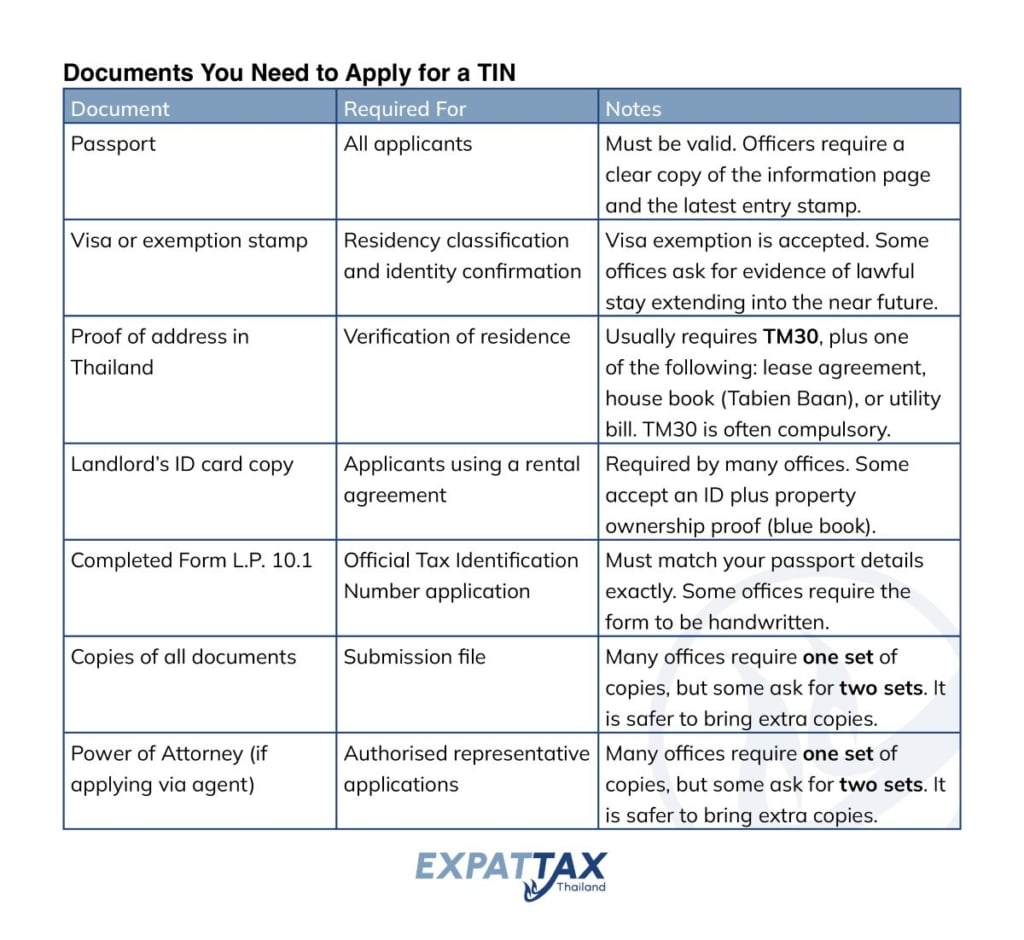

Note: Your address documents must match TM30 records. Inconsistent information is the most common cause of rejection.
How to Apply for a Thailand TIN (Step-by-Step)
Here is a straightforward guide to applying for a TIN in Thailand.
- Prepare your documents
Check that passport, visa and address proof match. Small discrepancies cause delays.
- Complete Form L.P. 10.1
Provide your full name, nationality, passport number, Thai address and visa status.
- Identify your correct district Revenue Office
Applications must be submitted at the office responsible for your residential address.
- Visit the Revenue Office
Take a queue number for registration. Not all offices have English-speaking staff, so bringing a Thai speaker often helps.
- Submit your documents
Officers will review your file. If TM30 information does not match your address, you will be sent to Immigration to update it before you can proceed. Some offices also ask for additional copies or landlord confirmation, so extra paperwork can be helpful.
- Processing time
Some offices issue the TIN immediately. Most take one to three working days. You may be asked to return to collect the printed TIN slip.
- Receiving your TIN
You will receive your TIN on paper. Keep a copy because you may need it for future filings or applications. In practice, a taxpayer number is generally intended to remain associated with you for future filings, but procedures can vary and you should keep the original record safe.
How to Check Your TIN If You Lose It
Visit your district Revenue Office with your passport and proof of address. Officers can retrieve the number for you. Public options to recover a lost TIN online are limited, so an in-person visit is commonly required.
Looking for an Easier Process?
If you prefer not to visit the Revenue Office yourself, our online TIN application service is simple and quick to complete. Our team prepares your documents, submits the application on your behalf and usually delivers your TIN in under two weeks.

Where to Apply – Tax Office Finder
Every district has its own Revenue Office and you must apply at the one that covers your registered address. Applications cannot be submitted at the wrong branch, even if it is more convenient.
How to Find the Correct Office
- Identify your district or amphur
- Search ‘Revenue Department [district name]’
- Check the opening times
- Bring copies of all documents and ensure your TM30 matches the address you provide
Common Tax Office Locations for Expats
Bangkok – Din Daeng, Sathorn, Bang Na and Phaya Thai offices handle large numbers of expats.
Chiang Mai – The main Revenue Office near the Old City handles most foreign applications.
Phuket – Patong, Kathu and Phuket Town offices each cover different residential zones.
These examples reflect common searches such as ‘Bangkok tax office for foreigners’ or ‘Where to apply for tax ID Chiang Mai’, which helps readers find practical information more quickly.
Can You Apply for a TIN Online?
The Revenue Department does not provide an online system for foreigners. You must apply in person at your district Revenue Office, or appoint an authorised representative to submit the application on your behalf.
Most expats choose to use a representative because it avoids the need to visit the office and ensures the documents are prepared correctly.
Advantages of Using an Agent to Apply for a TIN
- No need to visit the Revenue Office
- No language issues
- Correct district identification
- Correct document preparation
- Faster processing
- Avoidance of common errors
- Support if the Revenue Office requests additional documents
Expat Tax Thailand offers a secure online service. You upload your documents and we handle the rest from preparation to submission.
Common Problems When Applying (and How to Avoid Them)
Wrong District Office
Your application is rejected if you apply at the wrong branch.
Check your amphur in advance and confirm the Revenue Office responsible for your address.
TM30 Not Updated
Revenue officers check Immigration records. If your address is not updated, they cannot accept the application.
Update the TM30 before visiting the Revenue Office to avoid being turned away.
Landlord Refuses to Provide ID
This is a common issue with long-term rentals.
If the landlord will not provide identification, officers may accept other supporting documents such as a house book or written confirmation depending on the district. An agent can advise on acceptable alternatives.
Address Inconsistencies
Your lease, TM30, utility bills and passport must align.
Even small differences can delay the application, so ensure all documents show the same address format.
Applying Before 180 Days
You may apply early if you have Thai-sourced income, property income or filing duties.
Policies vary by office. Some accept applications immediately when Thai income is involved, while others require evidence of long-term stay.
Visa Complications
Frequent border runs or unclear visa status can lead to additional checks.
Bring copies of all visa stamps or extensions so officers can verify your status.
What Happens After You Receive Your TIN
Your TIN connects you to the Thai tax system and is required for filing returns, reporting income and complying with international information-sharing rules.
Tax Filing Duties
If you remit assessable foreign income into Thailand, you must file a personal income tax return. Your TIN is required before you can submit the return.
Remittance Rules
Thai law and Revenue Department guidance can treat foreign-sourced assessable income as taxable when it is brought into Thailand, depending on timing and the taxpayer’s circumstances. Revenue Department orders related to Section 41 state that the updated approach does not apply to assessable income that arose before 1 January 2024.
Evidence matters: In practice, you may need to support the year the income arose and how a remittance should be classified (for example, whether it relates to pre-2024 amounts or later income). Keeping clear bank records and tracing documentation is important.
CRS Reporting
Thailand participates in the Common Reporting Standard. Banks share financial information with tax authorities internationally, and your TIN ensures that data is matched correctly to your tax record.
Allowances and Deductions
Once you file a return, you may be eligible for personal allowances, spousal allowances, age-related allowances and certain deductions such as life insurance premiums or approved contributions.
Filing Even Without Thai-Sourced Income
If you remit assessable foreign income, you must file a tax return even if you did not earn any Thai-sourced income.
Apply for Your TIN Online with Expat Tax Thailand
If you would like a fast and stress-free process, we can obtain your TIN for you. Our licensed team prepares your documents, works directly with the Revenue Department and resolves any issues on your behalf. You submit your documents through our secure online portal and we take care of the rest.
We have helped thousands of expats and have more than 600 five-star Google reviews.
If you have any questions about Thailand Tax ID numbers or other tax matters, you are welcome to book a free call with our support team who will be happy to help.
Useful Links
Thai Revenue Department – Revenue Code Section 41 (Thai): https://www.rd.go.th/5937.html
Revenue Department Order (Por.162/2566) clarifying “does not apply to income arising before 1 Jan 2024”: https://www.rd.go.th/fileadmin/user_upload/kormor/newlaw/dn162A.pdf
OECD – Common Reporting Standard (CRS): https://www.oecd.org/en/publications/consolidated-text-of-the-common-reporting-standard-2025_055664b1-en.html
Revenue Department ServiceTIN (verification service): https://www.rd.go.th/28330.html
Frequently Asked Questions about our TIN Application Service
TIN
Yes, we have designed our service to be user-friendly. You can easily share your information and documents, and our real-time messaging service allows our support team to assist you with any issues.