Estate Tax & Tax Compliance in Thailand
Managing Tax Implications During Estate Administration
- Reviewing Thai income tax exposure arising from estate transactions
- Analysing capital gains and tax consequences of asset transfers
- Advising on remittance and estate distribution structures
- Trusted by expats and international families across Thailand


Thai Estate Tax & Compliance
Understanding Tax Implications During Estate Administration
Estate administration in Thailand can create tax implications when assets are transferred, sold, remitted into Thailand or distributed to beneficiaries.
Depending on the nature of the assets involved, this may give rise to income tax exposure, capital gains implications or reporting obligations.
Where an estate includes property, corporate holdings or international assets, careful planning may be needed to manage these issues in a compliant and tax-efficient way.
Our role is to help executors and families understand the Thai tax position, address relevant compliance requirements, and support the administration process as it progresses.
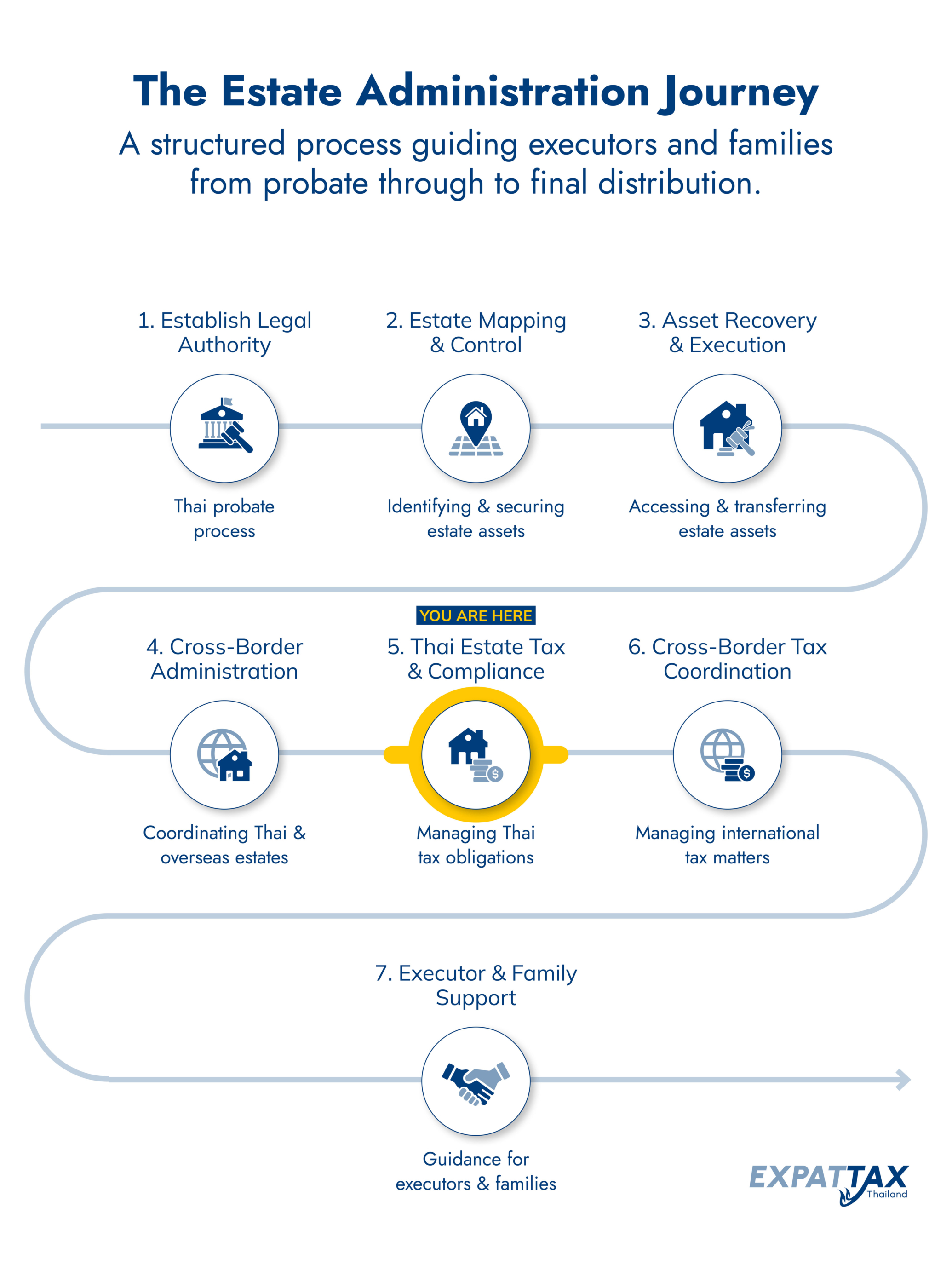

When Estate Tax and Tax Compliance Support Is Needed
Thai Estate Tax & Compliance support is often required when:
- Estate assets are sold or transferred during administration
- Property or investment assets may trigger capital gains tax considerations
- Estate funds are transferred into or out of Thailand
- Assets are held through Thai companies or other corporate structures
- Estate assets generate income during the estate administration period
- Beneficiaries have different tax residencies or reporting obligations
- Executors require guidance on Thai tax reporting for estate transactions
How Tax Review Fits into the Estate Administration Process
Estate administration in Thailand can create tax implications when estate assets are sold, transferred, remitted into Thailand or distributed to beneficiaries.
This stage focuses on reviewing those Thai tax implications so executors and families can move forward with greater clarity and confidence.
Depending on the nature of the assets involved, this may give rise to income tax exposure, capital gains implications or reporting obligations.
Where an estate includes property, corporate holdings or international assets, careful planning may be needed to manage these issues in a compliant and tax-efficient way.
Our role is to help executors and families understand the Thai tax position, address relevant compliance requirements, and support the administration process as it progresses.
What Thai Estate Tax & Compliance Involves

Thai Income Tax Review for Estate Transactions

Capital Gains Review for Estate Assets

Remittance Planning for Estate Funds

Corporate Tax Considerations in Estate Administration

Estate-Year
Tax Filing
and Reporting
How the Estate Tax Review Process Works
1.
Estate Transaction Review
We review the planned asset transfers, sales or distributions involved in the estate.
2.
Tax Exposure Analysis
Potential Thai tax implications are identified and assessed.
3.
Structuring Guidance
Where appropriate, we provide guidance on how transactions may be structured to manage tax exposure.
4.
Compliance Preparation
Relevant tax filings or reporting obligations are prepared where required.
5.
Ongoing Advisory Support
Executors receive guidance as estate administration progresses.
Why Families Choose Expat Tax Thailand


Trusted by the
Expat Community in Thailand
Hundreds of verified five-star reviews from expats and international families.

Experience Supporting
Cross-Border Estates
We regularly assist families where heirs, assets or advisers are located across multiple countries.


Integrated Estate
and Tax Expertise
Our team combines estate administration coordination with deep knowledge of Thai tax rules.


Coordination Across
Institutions and Jurisdictions
We assist executors dealing with banks, registries, advisers and institutions across multiple jurisdictions.

Transparent Scope and
Clear Expectations
We begin with a structured assessment, so responsibilities and expectations are clearly defined.
What Our Clients Say
Need Help Understanding Estate Tax Implications in Thailand?
Estate administration can involve important tax considerations, particularly when assets are transferred, sold or distributed.
If you would like guidance on the Thai tax implications that may arise during estate administration, our team can help you understand the next steps.
THAI ESTATE TAX & COMPLIANCE
A range of tax issues can arise during estate administration in Thailand, depending on the nature of the assets involved and the steps taken during the process.
These may include tax questions linked to the sale or transfer of property, the receipt or remittance of funds into Thailand, income generated by estate assets during administration and reporting obligations connected to particular transactions.
In some cases, capital gains, income tax or other compliance requirements may need to be reviewed before assets are transferred or distributed. Estates that include property, business interests or international assets may require particularly careful consideration.
For this reason, tax issues are often best reviewed before major estate transactions take place, so the administration can proceed in a compliant and orderly way.
Tax considerations are usually best reviewed before major transactions take place, such as selling property, transferring shares or distributing funds.
By reviewing transactions in advance, executors and families can better understand potential tax implications and ensure that the estate administration process proceeds in a compliant and structured way.
This depends on several factors, including the type of asset received and the tax residency of the beneficiary.
In many cases the key tax considerations arise during the administration process itself rather than at the moment beneficiaries receive assets, but each situation should be reviewed individually.
Transferring funds into or out of Thailand during estate administration may have tax implications depending on the origin of the funds and the timing of the transfer.
Executors and families often seek guidance to understand whether any reporting or tax considerations arise from cross-border transfers.
In some cases they can. For example, rental income from property, dividends from investments or interest earned on funds held as part of the estate may create income that needs to be reported during the administration period.
Executors may need to ensure that any required tax reporting is properly addressed.
Thai inheritance tax applies to assets received from a deceased person when the value inherited by an individual beneficiary exceeds the legal threshold.
The tax rules apply regardless of whether the beneficiary is Thai or foreign. However, the tax is calculated separately for each beneficiary and only applies to the portion of assets that exceeds the applicable threshold.
In many cases, estates fall below this threshold and inheritance tax may not apply. Even where inheritance tax is not triggered, other tax considerations may arise during estate administration, particularly when assets are sold, transferred or generate income.
Yes. If inherited property is sold during the estate administration process, the transaction may give rise to tax implications depending on the ownership structure and how the property is transferred.
These considerations may include withholding tax, personal income tax arising from the sale of property or other transaction-related taxes under Thai law.
Thailand does have an inheritance tax, but it applies only when assets received by an individual beneficiary exceed the applicable tax threshold.
In many cases, estates fall below this threshold and inheritance tax may not apply. However, certain transactions that occur during estate administration such as selling assets, transferring property or receiving income from estate assets may still create tax obligations under Thai law.
The specific tax implications depend on the nature of the assets involved and the transactions carried out during the administration process.