
Losing a relative is painful in any circumstance. When the death occurs in another country, the situation becomes even harder. Families often find themselves needing essential documents from Thailand at a time when they feel overwhelmed and unable to travel. The most important of these documents is the Thai death certificate. It is the official confirmation of the death and it is required for nearly every legal, financial and administrative step that follows.
The good news is that you can obtain a Thai death certificate without travelling to Thailand. A representative can collect it on your behalf and arrange certified copies, translations and legalisation for use in your home country. This guide explains the full process, the documents required, how district offices work and how to manage everything from overseas with confidence.
What a Thai Death Certificate Is and Why It Matters
A Thai death certificate is issued by the local district office in Bangkok and Amphur offices in other provinces. It is the primary legal document confirming the death and it is required for:
- Probate applications in Thailand or overseas
- Insurance claims
- Registering the death in your home country
- Accessing bank accounts, pensions or property
- Repatriation of remains or ashes
- Closing accounts or managing benefits
The document is written in Thai. Only one original is issued. Certified copies can be requested at the same time and this is strongly recommended because obtaining duplicates later requires a lawyer.
A hospital certificate of death is not the same as a Thai death certificate. Hospitals issue a medical certificate confirming the cause of death. The Amphur issues the official legal certificate and must register the death within 24 hours of notification.
Who Can Obtain a Thai Death Certificate
The following people may collect a Thai death certificate:
- The next of kin
A spouse, parent, adult child or sibling may request the certificate. Following Thailand’s legal reforms in January 2025, same-sex spouses are recognised as next of kin for this purpose.
- A legally appointed representative
This is the most common option for families overseas. A representative acts under a power of attorney and can complete the full process on your behalf. You can learn more about how to appoint a legal representative from overseas here.
- A funeral director or legal service provider
These providers often collect the certificate as part of their service, especially when arranging cremations or repatriation.
What Embassies Cannot Do
An embassy cannot collect the death certificate for you. The embassy may verify next-of-kin status and issue a supporting letter, yet the collection must be made by a representative in Thailand.
Documents Required to Obtain a Thai Death Certificate
A representative must present several documents to the Amphur. Requirements vary by province, although the following documents are generally required:
- Passport of the deceased
- Passport or Thai ID card of the representative
- Medical certificate confirming the cause of death
- Post-mortem summary if one took place
- Police notification form for deaths outside a hospital
- Embassy letter confirming next-of-kin status, often requested by Amphur offices
- Marriage certificate if a spouse is making the request
- Power of attorney if a representative is acting
- Proof of payment for hospital or mortuary fees
Completeness of documentation is one of the most common causes of delay. A representative in Thailand can collect missing documents directly from the hospital or police to avoid further complications.
How the Process Works in Thailand
Obtaining a Thai death certificate involves three main stages. Understanding these steps makes the process clearer and helps avoid delays.
Step 1: Hospital or Police Issue the Initial Documentation
The procedure differs depending on where the death occurred.
Hospital Deaths
The hospital issues a medical certificate stating the cause of death. The hospital also notifies police, as all foreign national deaths must be recorded. The medical certificate is then passed to the District Office or Amphur.
Deaths Outside a Hospital
Police attend the scene, arrange transfer of the body to a hospital and issue the initial report. A post-mortem is usually required. Once the examination is complete, police forward the documentation to the district office or Ampur.
Step 2: The District Office or Ampur Records the Death
The Amphur verifies the identity of the deceased, reviews the medical or police documents and officially records the death in the civil register. Thai law requires this registration within 24 hours of notification.
The Amphur then issues:
- The Thai death certificate
- One certified copy
- Additional copies on request
Some Amphur offices only issue extra certified copies during the same visit. Others allow later collection, although it is simpler to request all required copies at once.
Hospitals in large provinces sometimes liaise directly with the Amphur, although a representative may still need to attend if signatures or additional documents are required.
Step 3: Collecting the Original Certificate
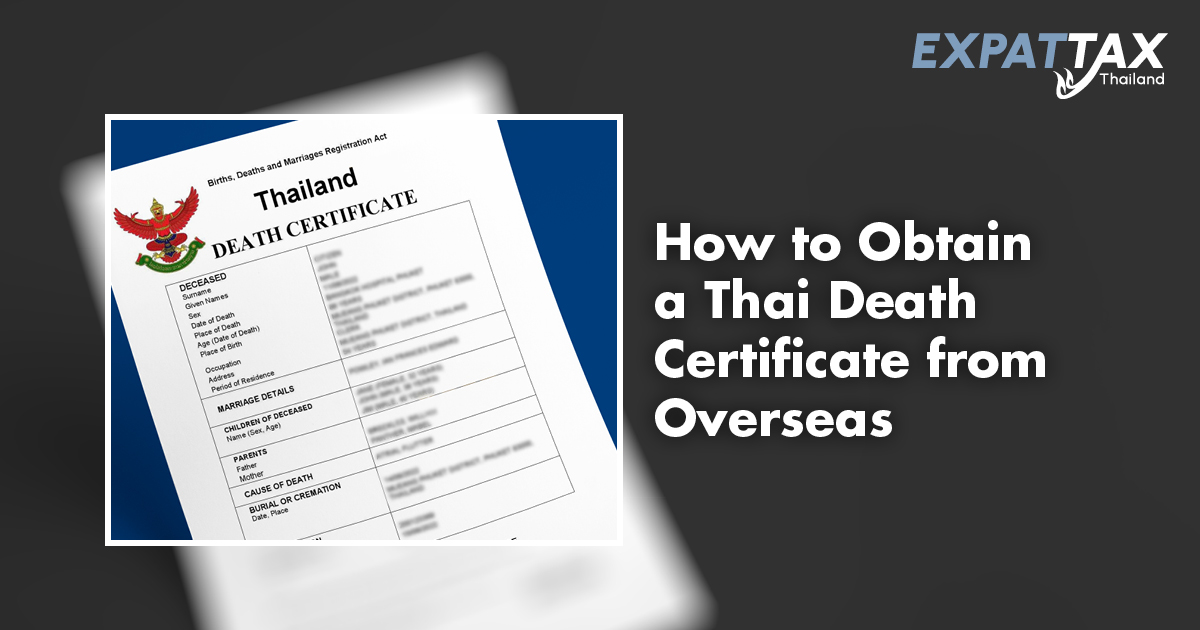
The representative signs for the original certificate and collects all copies. The certificate is printed in Thai and includes the name, date of death, place of death and personal details. This document becomes the foundation for all subsequent legal and administrative processes.
How to Obtain a Thai Death Certificate from Overseas (Without Travelling)
Many families cannot travel to Thailand at short notice. The Thai system allows a representative to collect the certificate and complete all associated steps on behalf of the next of kin.
Option 1: Appoint a Representative Through a Power of Attorney
This is the most reliable option.
How It Works
- You sign a power of attorney naming a trusted representative.
- The power of attorney is notarised abroad and then legalised by the Thai embassy or consulate, as Thailand is not a party to the Hague Apostille Convention.
- The document is translated into Thai.
- The representative takes the power of attorney to the Amphur and collects the certificate.
- The representative can also request certified copies, arrange translations and arrange legalisation.
What the Representative Can Do
- Communicate with the hospital and police
- Collect all required documents
- Pay outstanding fees
- Sign on your behalf
- Collect the certificate and certified copies
- Arrange translations and legalisation
- Start further processes such as probate if needed
Option 2: Use a Funeral Director or Legal Service
Funeral directors and accredited service providers often collect the death certificate as part of their role, especially when arranging cremation or repatriation. This is suitable when the family prefers not to manage the administrative steps.
Option 3: Obtain Embassy Support
Embassies can:
- Verify next-of-kin status
- Issue letters supporting the representative
- Provide guidance on the process
Embassies cannot:
- Collect the Thai death certificate
- Override Thai legal requirements
Their support is most helpful when an Amphur asks for confirmation of next-of-kin status.
How to Translate and Legalise a Thai Death Certificate for Overseas Use
Most countries require the Thai death certificate to be translated and legalised before it can be used for probate, insurance claims or registration of the death.
The full process involves three stages.
Stage 1: Certified Translation into English
The death certificate must be translated by a licensed translator. Accuracy is essential. Incorrect translations are rejected by the Ministry of Foreign Affairs and by embassies.
Stage 2: Legalisation by the Ministry of Foreign Affairs
The translated certificate is submitted to the Ministry of Foreign Affairs Legalisation Division in Bangkok.
The Ministry verifies that:
- The certificate was issued by a recognised Thai authority
- The translation is accurate
- All signatures and seals are genuine
Since 2025, legalised documents include a QR code and enhanced security seals. Appointments are required and are often booked one to two weeks ahead.
Legalisation normally takes two to seven working days once accepted.
Stage 3: Consular Authentication
Some countries require an additional step.
Examples
- United Kingdom: Authentication may be required depending on the intended use.
- United States: A Consular Report of Death Abroad usually replaces the need for authentication.
- Australia: Requirements vary by state.
After authentication, the certificate can be used for probate, insurance and estate administration in your home country.
Registering the Death in Your Home Country
Each country has its own rules.
United Kingdom
Registration is optional. Families may create a UK record of the death through the General Register Office or rely solely on the Thai certificate.
United States
Families may request a Consular Report of Death Abroad. This serves as the official U.S. record and is used for estates, pensions and Social Security.
Australia
Registration follows the rules of the relevant state or territory.
European Union
Most EU member states accept a Thai death certificate once it has been translated into the national language and legalised by the Thai Ministry of Foreign Affairs. Some countries also require consular authentication. Registration of an overseas death is not always mandatory, although each country has its own rules.
Examples include:
- France: Registration through the local French embassy or consulate is optional. Families may register the death in France so that it appears in French civil records.
- Germany: Registration is optional. The Thai death certificate must be translated into German and legalised. Some authorities ask for a German-certified translation.
- Netherlands: Thai death certificates are accepted once legalised. Registration is optional but may be requested for estate administration.
- Spain: Legalised and translated Thai death certificates are accepted. Registration may be required when dealing with Spanish estates or pensions.
Most EU governments advise families to consult their local civil registry office (Gemeinde, Ayuntamiento, Mairie, Standesamt or equivalent) to confirm whether local registration is needed for probate or inheritance matters.
Expected Timeframes
In most cases:
- Thai death certificate: 1–3 working days
- Certified copies: same day
- Translation: 1–3 days
- MFA legalisation: 2–7 working days
- Embassy authentication: 1–5 days
Appointment availability, public holidays and incomplete documents may extend timelines. MFA appointments are often booked one to two weeks ahead.
Costs
Typical costs include:
- Certified translation: THB 800–1,050 per page
- Legalisation at the Ministry of Foreign Affairs: THB 400–800 per document
- Embassy authentication: varies by country
- Representative service fees: varies depending on the work involved
No fee is charged for the issuance of the Thai death certificate itself, but there is a THB 10 fee per document for certified true copies from the registrar.
Common Problems Overseas Families Face
Families often report confusion or delays due to:
- Uncertainty over required documents
- Confusion between the medical certificate and the official Thai death certificate
- Missing embassy letters confirming next-of-kin status
- Variations in document requirements between Amphur offices
- Delays with power of attorney notarisation and legalisation
- Incorrect translations rejected by MFA or embassies
- Slow communication with hospitals or rural police stations
- Thai public holidays affecting opening hours
A representative in Thailand can prevent or resolve these issues quickly.
Checklist: How to Obtain a Thai Death Certificate from Overseas
- Confirm the death with the hospital or police.
- Appoint a representative through a notarised and legalised power of attorney.
- Ensure the representative has the deceased’s passport and all medical or police documents.
- Ask the embassy to issue a letter confirming next-of-kin.
- Allow the representative to collect the death certificate and certified copies.
- Arrange certified translations.
- Submit the documents to the Ministry of Foreign Affairs for legalisation.
- Obtain consular authentication if required.
- Register the death in your home country if needed.
Support Available for Overseas Families
Obtaining a Thai death certificate from overseas is entirely possible, although it involves coordination between hospitals, police, the district office and government agencies. Families often find the process confusing during a time of grief.
Our English-speaking team assists overseas families with every stage. We can collect the certificate, secure certified copies, manage translations, arrange legalisation and support further steps such as probate or asset recovery. If you would like guidance on what to do next, you can book a free call with our support team.


